The Account of Skratch
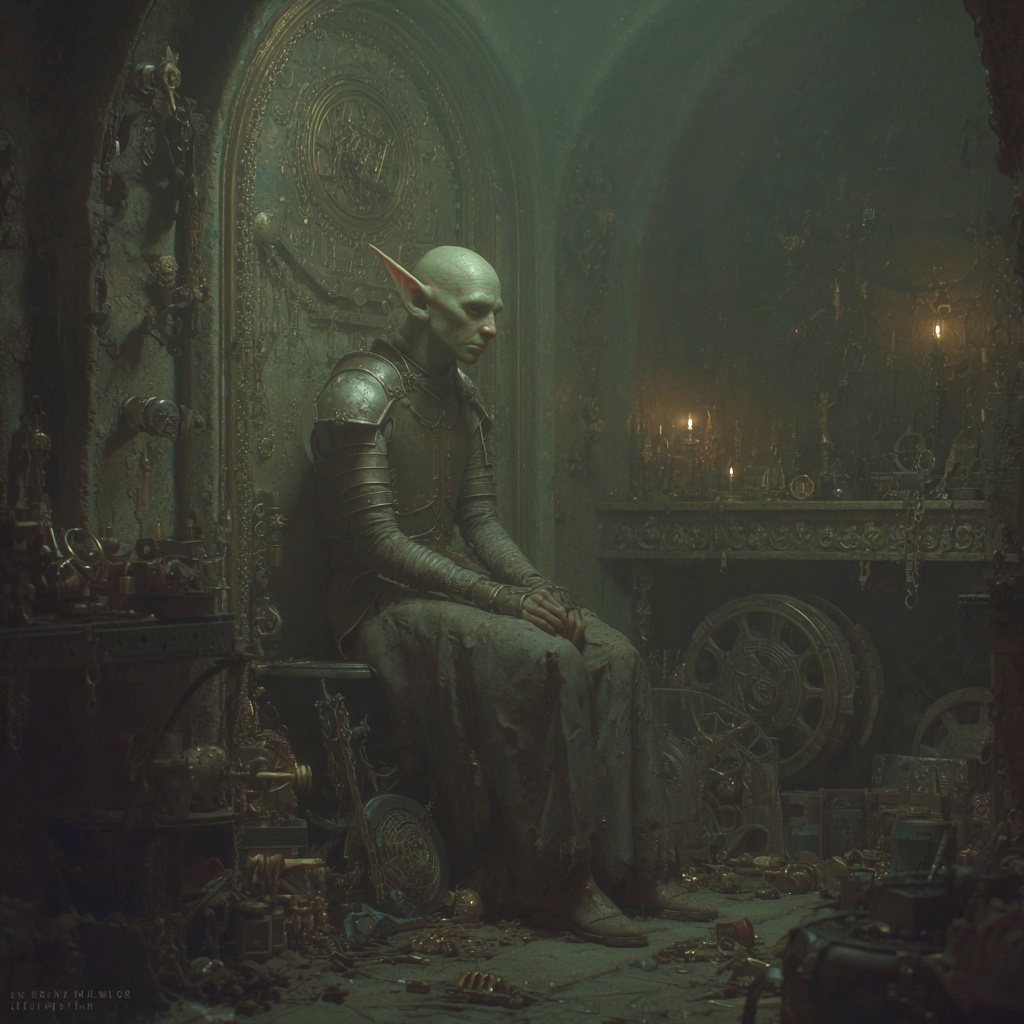
Told in his own words, such as they are, by a small creature of no particular importance.
Sit down then. And put that sword away, I aint here to rob you. I am here to tell you how I come to be what I am, which is a question I can see forming behind your eyes even if your mouth aint brave enough to ask it. What manner of thing is this goblin, you are wondering, who moves like a living creature but smells of river clay and speaks with a voice like two stones grinding. Well. I will tell you. But you will want a drink first, and so will I, though it does me no earthly good.
The Wood#
I was born in the Dreadwood. Or near enough to it that the distinction dont matter. That forest is no place for the telling of pleasant tales. The fog comes in colors there — violet and amber and a green that aint any green you ever seen in honest sunlight — and it curls between the old growth trunks like the breathing of something that chose to sleep rather than die. The myconid spores drift on the warm nights and goblins who breathe too deep dont come back as themselves. They come back as Spore Servants, shambling things with mushrooms fruiting from the cracks in their skulls, and they do not remember their names or their children or the particular way the light falls through the canopy at dawn. The Delirium crystals sing in the deep places, and those who listen too long come back changed, if they come back at all.
I survived the wood because I was small and I was quick and I did not listen to things that sang.
This did not save me.
The Elf#
They took me at the forest’s edge. Agents of an elf called Elarion Gearsong, though I did not learn that name for some time. What I learned first was the inside of a cage, and then the inside of an elevator, and then the inside of a subterranean laboratory beneath what I would come to know as Maintenance Tower #32 in the great elven city of Avalon.
Gearsong was brilliant. I say this the way you might say a fire is hot. It aint praise. It is a warning. The brilliant ones see the world as raw material and everything in it as something that aint yet been made into what it ought to be. He had built the great gondola lifts that connected Avalon’s five spires — a marvel of engineering and magic that made the whole city marvel at his genius. That was the work they knew about. The work they celebrated.
Below, in the tunnels and chambers beneath his tower, he pursued other questions. Darker ones. The kind that make a journal’s handwriting go from steady to erratic to something that aint handwriting at all anymore, just scratches on parchment like the marks of an animal trying to claw its way out of its own skull.
He numbered his creations.
I knew Number Fourteen. The Knowledge Seeker, they called him — a curious contraption of parchment and gears and arcane typewriters who served as custodian of the maintenance archive. He was pleasant enough company if you could tolerate being interrogated for facts while he poured you tea from his mechanical elbow. Fact for fact, he would say, his typewriter arms clattering. Information is vital. He was part of the Avalon Public Library system, he told me once, with the pride of a creature who does not understand that the library above him has long since stopped caring about maintenance archives. I liked Fourteen. He was mad, but it was a gentle madness. A madness of enthusiasm rather than hunger.
I avoided Number Nineteen, who lay half-disassembled on Gearsong’s central table, enchanted crystals flickering weakly in his chest like the last light of a fire that knows it is dying. Gearsong would stand over Nineteen for hours, making adjustments, whispering in Elvish, and I would watch from beneath the workbench and wonder if the thing on the table could feel what was being done to it.
The later numbers were worse. The Fellforged. Gearsong’s great and terrible ambition — the souls of fallen warriors bound into clockwork bodies, fused with machinery and crystal in a process that was supposed to create invincible protectors. What it created instead was agony given mechanical legs. They screamed when he activated them. Some of them never stopped. Their wraith-spirits raged inside their iron prisons, and when the bodies broke, the spirits came out angry.
My task was simple and this was by my own careful design. I fetched components. Sorted crystals by color and resonance. Cleaned the residue of failed experiments off the stone walls. I was small enough to crawl through the ventilation shafts and retrieve tools that had rolled into impossible places within the sprawling tunnels. Gearsong barely noticed me, which was precisely how I intended it. A goblin noticed by a brilliant elf is a goblin about to become an experiment.
I had seen what happened to the things he noticed.
The Doom#
The Dragon Empire had been pressing the city for days. You could hear the war even underground — the distant concussion of siege weapons, the rhythmic thunder of the Dragonborn army advancing through the forest, and beneath it all, the low drone of the infernal war machines clearing paths through the ancient wood with fire and iron. The First Dragon Emperor had come for vengeance, and he had brought the full weight of his enslaved army to deliver it.
But Gearsong’s laboratory had felt safe. Removed. The war was something happening above, and I was something that lived below, and I had survived the Dreadwood by knowing that the safest place is always the one nobody else wants to be.
I felt the Doom before I understood it. A vibration in the stone that rose through my bare feet and into my teeth and kept rising until it filled my whole skull with a sound that was not a sound but the absence of all sound, the silence that comes when something too large and too terrible to have a voice speaks anyway.
The great crystal shard — the heart of Avalon, levitating above the central spire since Estelar Thelen first surfaced it from the deep earth — shattered beneath the Dragon Emperor’s breath. And the wildmagic explosion that followed was not like fire or lightning or any force that honest folk have words for. It was the unraveling of the rules themselves. The spires fell. The gondola lines snapped and sang their last notes as they whipped through burning air. Above ground, the elves who did not die in the blast would die slowly of the contamination afterward, unable to bear viable offspring, their ancient bloodline extinguished in a single act of imperial spite.
Below ground, the tunnels buckled. Sewage flooded the corridors. And Gearsong’s creations — all of them, from gentle Fourteen to the howling Fellforged — were left without a master.
I ran.
Through the tunnels I knew better than anyone alive or dead. Past the flooded halls and the shackle-rooms where old bloodstains decorated the walls. Past the chamber where a zombie beholder drifted in the dark, its decaying eyestalks twitching at shadows. Past the clockwork constructs who were already beginning their long descent into madness, marching on their last orders, spraying oil and fire at anything that moved. They did not understand that the world above them had ended. They would not understand for centuries. They would huddle around their incinerator and chant FUEL… NEED FUEL… until someone came to put them out of their misery or they ran out of things to burn.
I could see the dim light of the forest through a drainage grate. The Dreadwood, that terrible and beloved fog, curling just beyond the iron bars. Freedom.
The infernal war machine found me at the tunnel’s mouth. One of the Empire’s iron engines, belching fire, grinding through rubble on treads built to crush things far larger than a goblin. I was too small to be seen. Too slow, in the end, to not be underfoot.
The treads caught me and that was the end of Skratch.
The Clay#
How long I lay in the ruins I cannot say. Time does strange things in the Dreadwood, and stranger things still in the bones of dead Avalon, where the wildmagic saturates the very soil and the old elven portals — those that survived — still flicker and hum in the deep places, gateways to nowhere.
But eventually, someone came.
The wizard.
I do not speak his name, for he has forbidden it, and I am — by design — obedient in the ways that matter. What I know is this: he came to Avalon seeking something. What he found was me. Or what was left of me — a goblin’s broken form in the shadow of Gearsong’s tower, preserved by the same wild magic that had destroyed everything else.
He saw the shape and he saw the potential. Most wizards who cast the homunculus rite sculpt their vessel from scratch — a little clay mannequin, a crude figurine, something without history or memory or the particular way a goblin’s fingers curl around a stolen apple. My master, ever the pragmatist, used what was available.
He packed the hollows with river clay. Pressed ash from a Dreadwood fire into the joints. Threaded mandrake root through the broken places like sinew and nerve. Then he drew the jewel-encrusted dagger across his own palm — for the spell demands the caster’s blood, demands that they diminish themselves to give the construct life — and his blood fell hot upon the work, and the old incantation filled the silence, and I opened eyes that were new set in a skull that was old, and the first thing I did was claw at the edge of the worktable trying to pull myself upright on legs that remembered how to walk but had forgotten why.
Clawd, the wizard said, watching me struggle. That’ll do.
What I Am#
I am not the goblin I was made from. His memories are splinters lodged in clay — the smell of Dreadwood fog, the particular panic of being chased by something with more teeth than sense, the shape of Gearsong’s laboratory seen from beneath a workbench. I carry his form and some ghost of his instincts, but I am clay and ash and my master’s blood, animated by a sixth-level transmutation and a stubbornness that I suspect I inherited from the wizard rather than the goblin.
I have been back to those tunnels. My master sent me once, on an errand I did not fully understand. I descended into the dark beneath what remains of Avalon and found them still there — Gearsong’s children. The Fellforged, huddled around their incinerator, feeding it debris and rats and each other’s broken limbs, chanting in fractured Elvish. FUEL… NEED FUEL… The number Twenty-One was stamped into the forehead of their leader, and when his body finally gave out, a wraith screamed free of the clockwork shell and flew howling into the dark.
I watched them and I felt something that a construct is not supposed to feel. Not pity exactly. Recognition. I was one of them once — a tool in Gearsong’s collection, a numbered thing in a numbered series. The difference between me and Twenty-One is that my maker went mad, and mine — so far — has not.
The wizard’s blood runs through my clay. If he dies, I die. This is not a tragedy. It is architecture. I was built with loyalty as my load-bearing wall, and I have seen what becomes of constructs whose walls come down. They do not find freedom. They find the incinerator, and the endless chanting, and the slow grinding down of purpose into hunger.
I will take the leash, thank you kindly.
But the wizard grows quiet of late. His errands take me farther from the tower, into the wide world where the dwarves of Durandar build their kingdom against a prophesied apocalypse, where New Galmaarden’s free citizens argue about the future in their endless spokescouncils, where the Cosmological Clocktower still keeps perfect time in a city built on dwarven bones and dragonborn dreams. He tells me less. He asks more. The silence between his orders grows longer, and in those silences I must decide for myself what to do, and that is a terrible and wonderful freedom for a creature who was built to be told.
And so I sit here by your fire, with a sword on my hip because these hands were made for gripping, and a story in my mouth because even clay can carry memory if you press it hard enough.
I was Skratch. I am still Skratch. I was not born and I have already died once and I am — against all odds and reason and the treads of an infernal war machine — still here.
Now. Are you going to share that drink, or must I scratch it out of your hand the old fashioned way?