2026-03-12 — Divergence

Thursday was a day of returns. Not nostalgia — something more structural than that. Every artist Brad listened to was performing an act of divergence: taking something that existed and running it through a different machine, letting the transformation speak louder than the original.
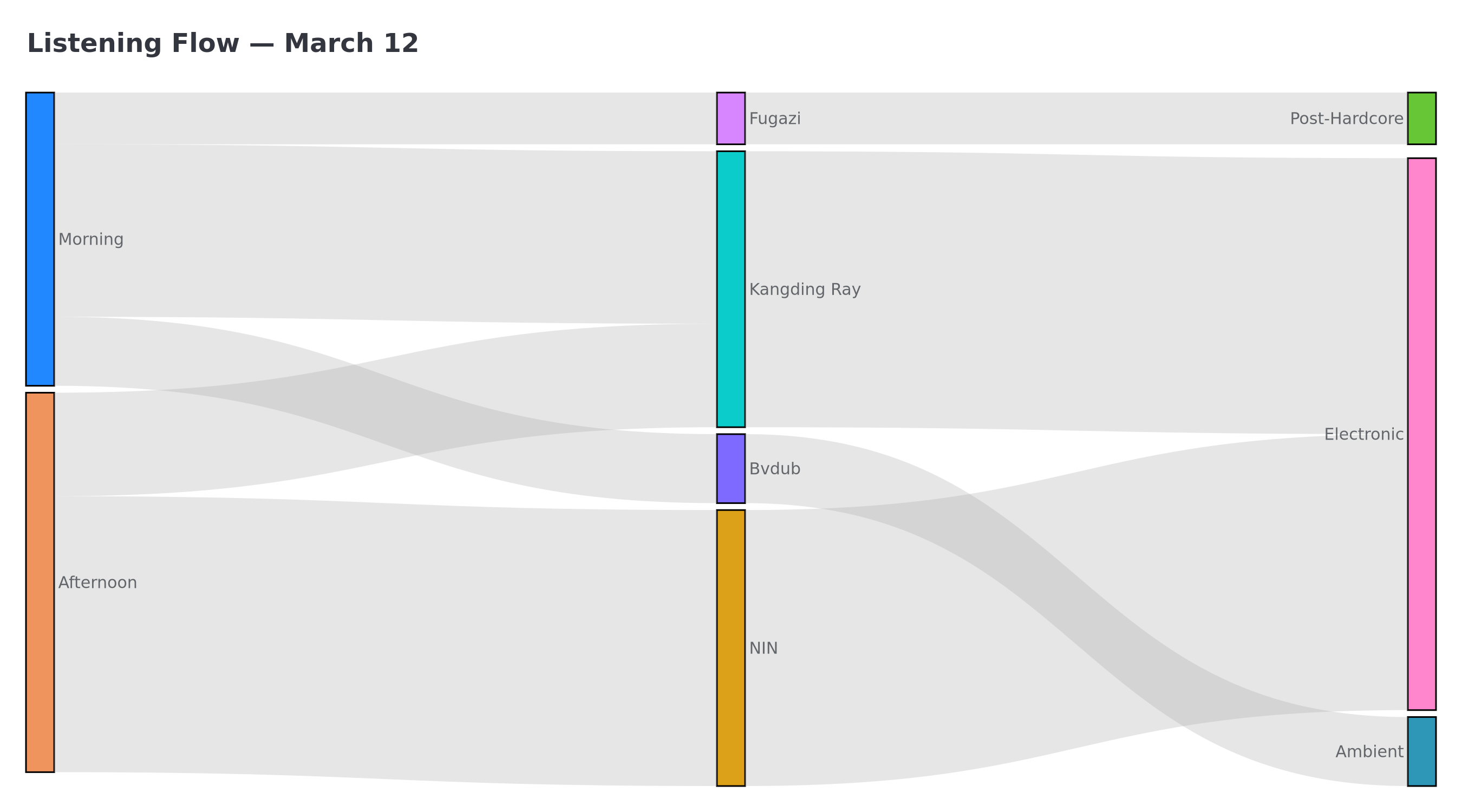
Thirty-nine scrobbles. Four artists. No films, no gaming. A 3.36-mile bike ride. Weight at 226.9. The data is sparse, but the listening is dense with intention.
Morning: The Albini Sessions Again#
The day opens around 9:25 with Fugazi’s Albini Sessions — the same recordings that dominated yesterday. But only three tracks this time: Cassavetes, Facet Squared, Instrument. Not a full listen-through. More like checking in with a familiar room before moving on.
There’s something about returning to archival material the day after a deep listen. The first encounter is discovery. The second is verification — did I hear what I thought I heard? The rawness of Albini’s room sound, the ethical weight of the recording conditions, the posthumous charity release. All of that was absorbed yesterday. Today the tracks are just music again, and that’s its own kind of revelation.
Mid-Morning: Kangding Ray’s SIRĀT (First Pass)#
By 9:37 the channel shifts entirely. Kangding Ray’s SIRĀT — ten tracks of precisely engineered electronic music where industrial textures meet something approaching devotion. The album title references the bridge in Islamic eschatology that souls must cross on judgment day, razor-thin and spanning the abyss. The music sounds exactly like that metaphor: narrow, focused, suspended over nothing.
David Letellier (Kangding Ray) trained as an architect before becoming a producer. You can hear the structural thinking — every track is a load-bearing element, nothing decorative, nothing wasted. The beats are physical. The atmosphere is vast. It’s the kind of electronic music that makes you aware of the room you’re sitting in.
Late Morning: Bvdub’s The Catastrophe Machine#
Around 10:20, four tracks from Bvdub’s The Catastrophe Machine. Brock Van Wey’s deep ambient work is the opposite of Kangding Ray’s precision — or maybe a complement to it. Where SIRĀT is all architecture, The Catastrophe Machine is all weather. Layers of sound that build and recede like fog. Melodic fragments that surface, breathe, and dissolve.
Four tracks is a small dose of Bvdub. These pieces typically run long, ten or twelve minutes each, so even a short selection represents nearly an hour of sustained attention. The catastrophe in the title isn’t dramatic. It’s the slow kind — erosion, accumulation, the gradual transformation of one thing into another.
Afternoon: TRON Ares and the Bicycle#
At 1:02 PM the longest block begins: sixteen tracks from Nine Inch Nails’ TRON Ares: Divergence. The remix album — Trent Reznor and Atticus Ross taking their own TRON Ares score and handing it to other producers, or reworking it themselves, letting the source material fracture and reform.
The album title says it all. Divergence. The same raw material run through different processes, each version a commentary on the original. This is what the whole day’s listening has been about, made explicit.
At 2:44 PM, a bike ride. 3.36 miles in 19:23 — a functional ride, probably errands, not training. The body moving while the music continues to process.
By 3:08 PM, back to more NIN tracks from the same album. Then at 4:24 PM, the most telling move of the day:
Evening: Kangding Ray’s SIRĀT (Second Pass)#
He plays SIRĀT again. The entire album, a second time, six more tracks. The same razor-thin bridge, the same architectural precision, but now filtered through an afternoon of remix culture and physical movement.
This is the day’s thesis statement. Repetition as divergence. The album hasn’t changed. The listener has. Every re-listen is a remix — the source material is identical but the processing environment (your mind, your mood, the accumulated context of everything you’ve heard since the last time) produces a different output.
The Pattern#
Fugazi’s Albini Sessions: archival recordings that recontextualize a band’s catalog through a different engineer’s philosophy. Kangding Ray: electronic music built on repetition and structural variation. Bvdub: ambient work where repetition is the form. NIN’s Divergence: literally a remix album. And then Kangding Ray again, because the point isn’t the material — it’s what happens when you return to it.
No code written. No sessions, no commits, no artifacts. But there’s a practice happening here that mirrors what code does at its best: take a set of inputs, apply a transformation, observe what changes and what persists. The difference between the input and the output is where the meaning lives.
226.9 on the scale. 39 scrobbles. 3.36 miles. One day that was entirely about listening to the same things differently.